


Stirrups Bending Machine: The Complete Guide to Faster, More Accurate Rebar Stirrups

If you manufacture rebar cages for beams, columns, slabs, or foundations, stirrups are not optional—they’re structural essentials. The difference between a smooth production line and constant rework often comes down to one thing: whether your stirrups bending machine can produce consistent angles, repeatable dimensions, and reliable throughput across different bar diameters and shapes.
As construction projects become larger and timelines tighter, contractors and prefabrication yards are shifting from manual bending to automated stirrup production. A modern stirrups bending machine improves speed, reduces labor dependency, and helps meet quality requirements on every batch. This article explains how a stirrups bending machine works, what specifications matter most, common applications, and how to choose the right model for your rebar workshop—so you can buy with confidence and improve ROI.
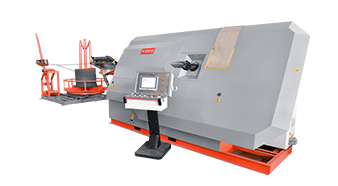
What Is a Stirrups Bending Machine?
A stirrups bending machine (often called a stirrup bender or rebar stirrup bending machine) is specialized equipment designed to automatically feed, measure, bend, and cut steel rebars into closed or open stirrup shapes. These shapes typically include squares, rectangles, polygons, and custom profiles used in reinforced concrete components.
Compared with manual or semi-manual bending, a dedicated stirrup bender provides:
Higher output (more stirrups per hour)
Better dimensional accuracy (repeatability across batches)
Reduced labor intensity (less manual handling and measuring)
Lower material waste (fewer wrong bends and scrap bars)
For rebar processing centers, the goal is not only speed—it’s producing stirrups that fit perfectly when assembled, with minimal correction on site.
How a Stirrups Bending Machine Works (Simple Workflow)
While designs differ by manufacturer and model, most automated systems follow a similar production flow:
Coil or bar feeding
The machine feeds straight rebar from a coil (or pre-straightened material depending on configuration).Straightening (if coil-fed)
Straightening rollers remove curvature from coil stock for accurate measurement and bending.Length measurement
Encoders and control logic ensure each segment matches the programmed dimension.Bending
Servo-driven bending heads form angles precisely (90°, 135°, etc.), producing consistent geometry.Cutting
The machine cuts the rebar at the programmed length, delivering finished stirrups ready for bundling.Collection and batching
Finished stirrups can be collected and bundled to match project schedules and bar bending lists.
For high-volume production, consistency and repeatability are just as important as raw speed—especially when you’re bending thousands of stirrups per shift.
Why Stirrups Bending Machine Accuracy Matters in Real Projects
Stirrups control shear reinforcement and confinement in critical concrete elements. Poorly formed stirrups create downstream issues:
Misfit during cage assembly (extra time adjusting on-site)
Incorrect cover spacing and alignment problems
Inconsistent hook angles and lengths
Increased inspection failures and rework
A reliable stirrups bending machine helps prevent these problems by using programmable controls and stable bending mechanics, producing consistent output that matches drawings and fabrication standards.
Key Specifications to Compare Before Buying
To rank well on Google and convert visitors into inquiries, a product page must answer the questions engineers and procurement teams actually search for. Here are the high-intent specs buyers evaluate when selecting a stirrups bending machine:
1) Supported rebar diameter range
Your diameter range should match your common stirrup sizes. Many projects require multiple diameters across beams and columns. Choose a system that supports your daily workload rather than a theoretical maximum.
2) Bending angle range and repeatability
Look for stable bending at standard angles (90° / 135°) plus custom angles for special shapes. Repeatability is the difference between smooth cage assembly and constant correction.
3) Production speed and throughput
Output is influenced by:
Feeding speed
Bending speed (servo performance)
Cutting cycle time
Shape complexity
A good stirrup bender supports high throughput without sacrificing accuracy.
4) Shape library and programming ease
A modern stirrup machine should support common stirrup geometries and allow operators to quickly program:
Rectangle / square stirrups
Multi-angle polygons
Custom profiles based on your BBS (Bar Bending Schedule)
An intuitive HMI (touchscreen) reduces training time and operator errors.
5) Cutting quality and tool life
Clean cutting reduces burrs and improves safety during handling. Tool material and design affect maintenance intervals and long-term operating cost.
6) Power, footprint, and integration
Confirm:
Power requirements and compatibility
Floor space and layout needs
Optional integration with straightening, cage welding, or bending center workflow
The best system is the one that fits your workshop and process—not just your budget.
Typical Applications of a Stirrups Bending Machine
A stirrup bender is widely used in:
Precast concrete plants (beams, columns, piles)
Rebar processing centers (BBS-driven mass production)
Infrastructure projects (bridges, tunnels, metro lines)
Commercial and residential construction (foundations, frames)
Industrial buildings (heavy reinforcement zones)
In these environments, production bottlenecks often appear at stirrup fabrication—especially when labor is limited. An automated stirrups bending machine helps stabilize output and reduce project risk.
Manual Bending vs. Automated Stirrups Bending Machine (Quick Comparison)
| Factor | Manual bending | Stirrups bending machine |
|---|---|---|
| Throughput | Low–medium | High, consistent |
| Accuracy | Operator-dependent | Programmable, repeatable |
| Labor requirement | High | Lower |
| Scrap rate | Higher | Lower |
| Standardization | Difficult | Easy (recipes/programs) |
If your business relies on consistent delivery and predictable capacity, automation is usually the better long-term strategy.
Common Problems (and How Good Machines Prevent Them)
Problem: inconsistent dimensions across batches
Cause: manual measurement variation or unstable feeding.
Fix: precise length measurement + stable feeding control.
Problem: wrong angles or incomplete bends
Cause: weak bending mechanism or poor calibration.
Fix: servo-driven bending + repeatable bending head design.
Problem: excessive downtime due to wear parts
Cause: low-quality tooling or insufficient maintenance access.
Fix: durable tooling, clear maintenance design, and spare parts support.
Problem: slow changeover between shapes
Cause: complex programming interface.
Fix: preset shape library + easy HMI programming.
Why Choose TJ K Machinery Group for Your Stirrups Bending Machine?
When purchasing rebar processing equipment, the real value is not only the machine—it’s the stability of production and the support behind it. TJ K Machinery Group focuses on practical reliability for rebar fabrication, offering stirrup bending solutions designed for real-world workshop conditions: continuous use, varying rebar quality, and demanding timelines.
If you’re evaluating a stirrups bending machine for your plant, a good next step is to match your required bar diameters, daily volume, and stirrup shapes to an appropriate configuration, and confirm integration requirements for your current workflow.
FAQs
Q1: What is a stirrups bending machine used for?
A stirrups bending machine is used to automatically produce rebar stirrups (rectangles, squares, and custom shapes) for reinforced concrete beams, columns, and other structural elements.
Q2: How do I choose the right stirrups bending machine?
Choose based on rebar diameter range, required throughput, shape complexity, programming interface, and how well the machine integrates into your workshop layout.
Q3: Are stirrup benders suitable for high-volume production?
Yes. Automated systems are designed for consistent, repeatable, high-throughput production—especially in rebar processing centers and precast plants.
-
How Can CNC Rebar Bending Machines Revolutionize Your Construction Projects?
May 29, 2025Manual rebar bending delays projects and wastes materials due to human errors. Last year, a bridge construction team lost $28,000 fixing bent steel placements. CNC rebar bending machines automate stee...view -
How to Choose the Appropriate Reinforced Mesh Welding Machine?
October 4, 2020Several parts like welding specifications, equipment construction and major configuration and other aspects should be considered.Welding specification: wire diameter is generally 5-12 mm, 3-6mm, 2-4mm...view -
How to Weld Wire Cages with Different Diameters
June 30, 2019The welding of wire in construction generally includes: flash butt welding, resistance spot welding, arc welding, electro slag pressure welding, the submerged arc pressure welding of T joint of embedd...view -
How to Operate Safely in Rebar Sawing and Thread Polishing Line
September 4, 2018Rebar sawing and thread polishing line is a necessary rebar processing equipment, such as rebar bender and cutter for large rebar processing enterprises.view -
The Correct Operation Rules and Improvements Measures of Wire Straightener
August 23, 2019Correct operation rules for wire straightener:(1) The equipment must be handled by a special-assigned person and he must be certified to work.(2) The operator is not allowed to leave the machine too f...view -
The Operation Principle of the Wire Straightening and Cutting Machine
September 7, 2019Operation principle: The motor accelerates through the belt driving, making the straightening cylinder rotate at a high speed, the steel bars passing through the straightening cylinder get straightene...view
- TEL:+86 22-26993766
- FAX:+86 22-26997888
- EMAIL:tjksales@tjkmachinery.com
- ADDRESS:Wuwei Rd., Lulugang Logistics Industrial Park, Tianjin, China
- Sitemap Privacy Policy
- Copyright © TJK Machinery (Tianjin) Co, Ltd All Rights Reserved